
IR Spectroscopy Machine
Overview
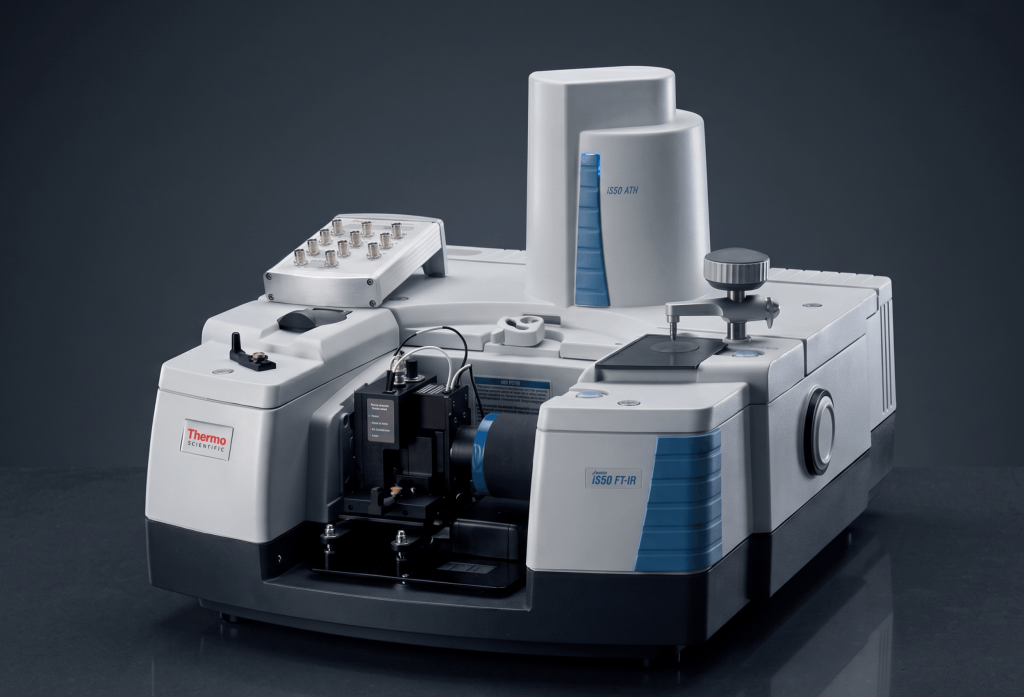
The IR Spectroscopy Machine (Infrared Spectrometer) is an analytical instrument used to identify and characterize chemical compounds by measuring their interaction with infrared radiation. It provides detailed information about molecular structure, functional groups, and chemical composition, making it an essential tool in pharmaceutical, chemical, food, environmental, forensic, and research laboratories. Modern IR spectrometers commonly use Fourier Transform Infrared (FTIR) technology for fast, accurate, and high-resolution analysis.
Principle of Operation
The instrument passes infrared radiation through or reflects it from a sample. Different chemical bonds absorb infrared light at specific wavelengths, producing a unique absorption spectrum. This spectrum acts as a molecular fingerprint, allowing identification of compounds and analysis of their chemical structure.
Key Features
- High-resolution infrared spectral analysis
- Rapid data acquisition using FTIR technology
- Wide spectral range for comprehensive analysis
- User-friendly software for data processing
- High sensitivity and measurement accuracy
- Automatic background correction
- Multiple sampling accessories available
- Compact and durable design
- Low maintenance requirements
- Suitable for routine quality control and research applications
Main Components
- Infrared Light Source
- Interferometer
- Sample Compartment
- Beam Splitter
- Detector
- Optical System
- Laser Reference System
- Control Panel
- Computer with Analysis Software
Technical Specifications
| Parameter | Specification |
|---|---|
| Instrument Type | FTIR Spectrometer |
| Spectral Range | 4000–400 cm⁻¹ (model dependent) |
| Spectral Resolution | Up to 0.5–4 cm⁻¹ (model dependent) |
| Detector | DTGS or MCT (model dependent) |
| Beam Splitter | Potassium Bromide (KBr) |
| Light Source | High-Intensity Infrared Source |
| Data Interface | USB / Ethernet (model dependent) |
| Software | FTIR Analysis Software |
| Power Supply | 220–240 V AC, 50/60 Hz |
Applications
- Compound identification
- Functional group analysis
- Raw material verification
- Pharmaceutical quality control
- Polymer and plastic analysis
- Food and beverage testing
- Environmental sample analysis
- Forensic investigations
- Research and development
Benefits
- Fast and accurate spectral analysis
- Non-destructive testing
- Minimal sample preparation
- High reproducibility and reliability
- Easy operation and data interpretation
- Suitable for solid, liquid, and gaseous samples
- Reliable performance for routine laboratory use
Sample Types
- Powders
- Tablets and capsules
- Liquids
- Oils
- Polymers
- Thin films
- Gases
- Food products
- Chemical compounds
Industries Served
- Pharmaceutical Industry
- Chemical Industry
- Food and Beverage Industry
- Petrochemical Industry
- Environmental Testing Laboratories
- Forensic Laboratories
- Universities and Research Institutions
- Quality Control Laboratories